If you’re having trouble reading this, click here.
MONDAY ECONOMIC REPORT
Manufacturers Remain Optimistic About Future as Home Sales Fall
October 26, 2026
By Victoria Bloom and Michael Green
Manufacturing-Focused Weekly Toplines
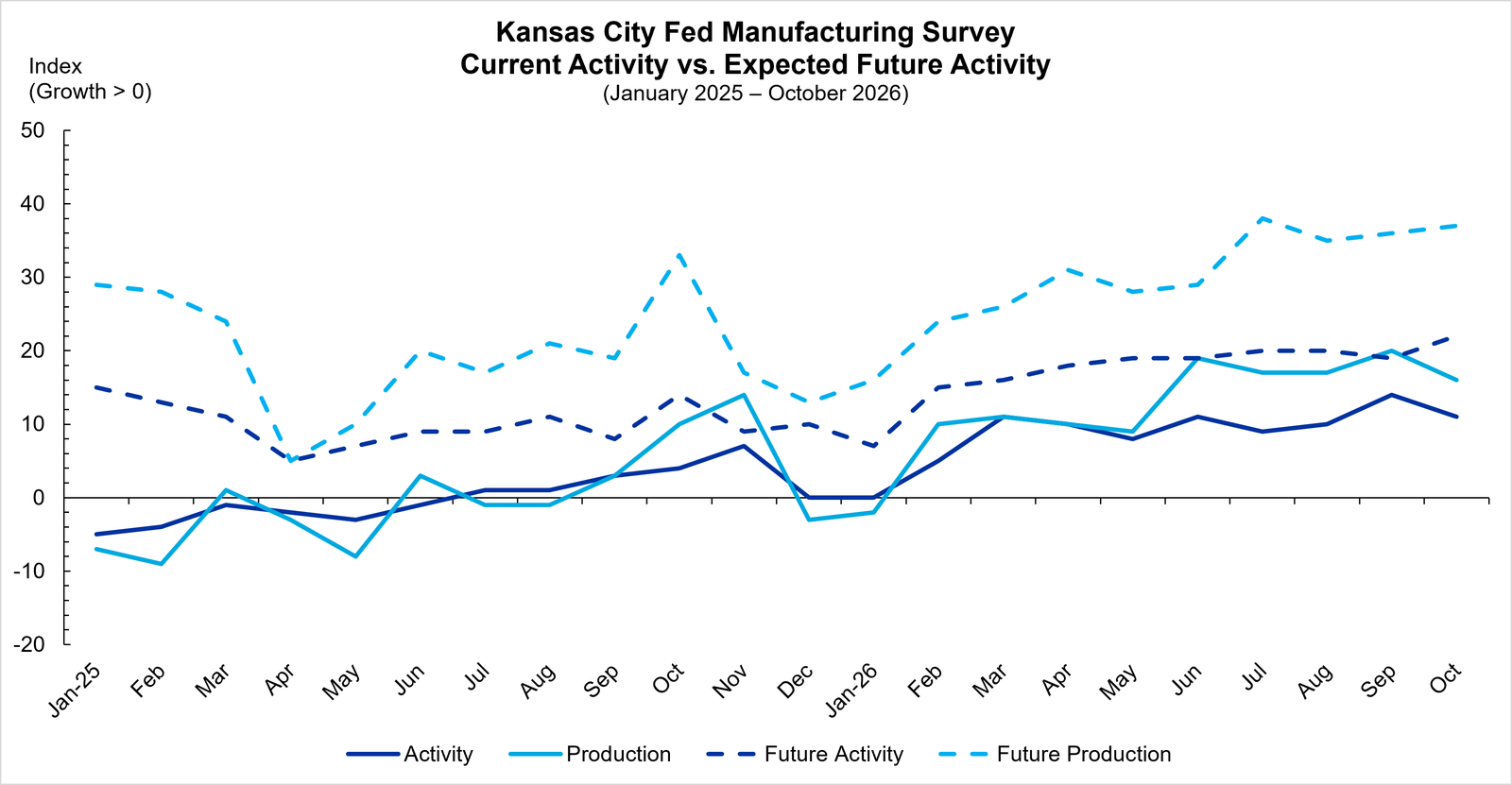
Kansas City manufacturing activity slows in October: The month-over-month composite index in the Tenth District decreased from 14 to 11 in October, while expectations for future activity rose from 19 to 22. The production index declined from 20 to 16, and the shipments index stepped down from 21 to 18. Meanwhile, the new orders index fell from 24 to 3, while the employment index edged up from 0 to 1.
Why it matters: Despite a slight drop in the headline rate, the majority of indices in Kansas City were positive in October. Looking forward, expectations for future activity hit their highest level since July 2022. That said, over half (53%) of firms said their customers are more price sensitive compared to six months ago.
Flash PMI signals faster expansion in manufacturing activity: The S&P Global Flash U.S. Manufacturing PMI edged up from 55.9 to 56.0 in October, a 53-month high. Factory production and new order growth slowed from recent highs but remained elevated. Manufacturing employment rose at its fastest rate since March 2012. At the same time, inventories increased in October, while supplier delivery times lengthened to the greatest degree since July 2022 as supply issues remain widespread.
What it means: While the Flash PMI is only an early estimate of manufacturing activity based on 85% of responses, it can give an indication of where activity is trending. The Flash PMI finds factory confidence returning to its long-run average, supported by strong demand. Elevated optimism about future conditions is also driving hiring, as overall employment rose at its second-fastest pace in four years in October.
Pending home sales fall to record low: The Pending Home Sales Index, which predicts home sales through contract signings, decreased to 66.0 in September, down from 71.2 in August. All four regions saw declines in September, led by sales in the West falling 9.2% over the month and 15.0% from September 2025.
Why it matters: High mortgage rates and worsening housing affordability led to the lowest level in the index since the survey started in 2001. In September, mortgage rates hit their highest level since January 2025 as housing demand remains sensitive to changes in rates.
This Week’s Economic Indicators
Monday, Oct. 26 Texas Manufacturing Outlook Survey
Thursday, Oct. 29 GDP (Q3 2026 Advance Estimate) Personal Income and Outlays PCE Price Index
Friday, Oct. 30 None
Deeper Dive
Kansas City Fed Manufacturing Survey: Manufacturing activity grew at a slower pace in the Tenth District in October, with the month-over-month composite index decreasing to 11 from 14 in September. Meanwhile, expectations for future activity rose from 19 to 22. The slowdown reflected softer activity among both durable and nondurable goods manufacturers. All indices except those for backlogs of orders and new export orders were positive in October. The Tenth Federal Reserve District encompasses the western third of Missouri; all of Kansas, Colorado, Nebraska, Oklahoma and Wyoming; and the northern half of New Mexico.
S&P Global Flash U.S. Manufacturing PMI: The S&P Global Flash U.S. Manufacturing PMI edged up from 55.9 to 56.0 in October, a 53-month high. Factory production and new order growth slowed but remained elevated. Meanwhile, manufacturing employment rose at its fastest rate since March 2012.
Pending Home Sales: In September, pending home sales fell 7.3% over the month and 11.3% over the year, with all four regions experiencing declines. The Pending Home Sales Index, which tracks contract signings as a leading indicator of future home sales, decreased to 66.0 in September from 71.2 in August.
By region, pending sales in the Northeast decreased 4.2% over the month and 9.4% over the year. The Midwest moved down 6.5% over the month and 8.7% over the year. Meanwhile, the South fell 8.2% month-over-month and 12.0% year-over-year. The West plummeted 9.2% over the month and 15.0% from September 2025.
The Pending Home Sales Index dropped to its lowest level on record in September. Elevated mortgage rates continue to weigh on affordability and buyer demand. Looking forward, job growth and income gains could support home purchases, but demand remains sensitive to changes in mortgage rates.
New Residential Construction: Building permits decreased 0.2% in September and 3.0% over the year. Permits for single-family homes in September fell 4.0% and 4.8% over the year. At the same time, permits for buildings with five or more units rose 5.9% from August and 1.0% over the year.
NAHB Housing Market Index: Builder confidence in the market for new single-family homes fell 3 points to 29 in October. All three components of the Housing Market Index declined in October. Present sales conditions dropped 2 points to 33, while expected sales in the next six months fell 5 points to 32. At the same time, prospective buyer traffic stepped down 5 points to 18. The share of builders cutting prices was 43% in October, up from 38% in September. Meanwhile, the average price reduction was 6%, unchanged from September.
University of Michigan Consumer Sentiment Index: In October, consumer sentiment decreased 0.2% to an index reading of 48.0, after declining 0.2% the prior month. Current economic conditions fell 8.3%, while the expectations index rose 5.4%. The decline in current conditions was driven by an 18% drop in buying conditions for durable goods. Overall, consumer sentiment is down 10.4% from a year earlier, while current economic conditions are down 20.3% from October 2025.
Year-ahead inflation expectations ticked up from 4.6% in September to 4.7% in October. Meanwhile, long-run inflation expectations stepped up from 3.4% to 3.5%, higher than the range seen in 2024. Expectations over both time horizons increased for the second consecutive month to their highest readings since May.